Salamanca Solutions International, Cochabamba, created the system. The system operates on text messages (sms) early warning. It applies in Haiti and Sierra Leone. In 2015 it will be installed in Pakistan and Kenya.
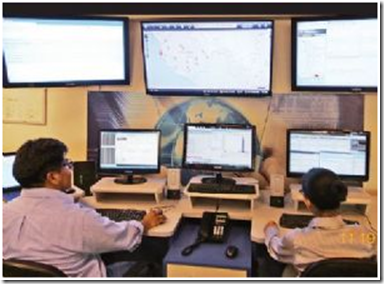

SSI. Area “monitoring” of Salamanca Solutions International.
Page Seven / La Paz
“If someone dies from suspected Ebola no body wash … and alert a health worker immediately. ” This is one of the alert messages that the Tera system, manufactured in Cochabamba, sent to the people of Sierra Leone.
The Tera software is designed to send text messages (sms) evacuation, logistics, or general information when disaster strikes (earthquake, hurricane, etc.), or seeks to counter the advance of a platform disease such as Ebola outbreak.
In 2010, the system was applied, together with the International Red Cross in Haiti, to alleviate the effects of the earthquake in that country, and such was the success that reached the program in 2013 that institution humanitarian installed it in Sierra Leone.
Ramiro Arraya, product manager of the firm Salamanca Solutions International, which developed the supporting reports that in Haiti were sent close 33 million messages and in Sierra Leone, around 21 million.
Unlike Haiti, where Tera was used to give relief to citizens in Sierra Leone it is used to provide information about health, health and education, among others.
Arraya explains that the Red Cross has a plan to implement the system in seven additional countries. So far, reports that in early 2015 will install in Pakistan (Asia) and Kenya (Africa).
The program can send messages “targeted” to specific geographical areas of a country. “For example, you should send a message in this case of Haiti and you can select a location map, where you can see the antennas which are hung subscribers and you can send a help message, alert or mobilization,” says the executive.
Also, is a system that is not unidirectional, it is also able to interpret the response messages of the population, and give the respective replica.
“The system can send different types of messages. You can send one-way messages. Ie you send to communicate. There is another for which we expect a response from the people, keyword, say: water (in reference to the resource is required) “.
This executive says the Tera system is “not intrusive” and therefore “does not break the confidentiality that has the user with its attendant”. It explains that the service provided to the population in countries where it is installed does not have a cost.
He added that this detail is something that any “attendant care” and that the company respects. “We do not break that,” says
Arraya says that the reasons for which appeals to SMS is that it is a “basic” service of the GSM cellular technology, which is available on any mobile device.; addition, the courier is one of the first to be replaced after a power failure.
Tera, so named for its acronym in English (Trilogy Emergency Relief Application), was developed in three months, but has more than three years of operation.
“The development of the system is quick and obviously has been gradual. We have tried to put the basics, as soon as possible and then has been complemented according to need we have seen with the International Red Cross, “says Arraya.
The company Salamanca Solutions International works in Cochabamba and although it is a local firm also has international investors.
“They rely on the ability of the Bolivian people, engineers here, and the objectives that we as developers of such complex systems” says.
Technology to humanitarian service
The technology to shovel the effects of disasters has become increasingly relevant in the world, as reflected in a report by the BBC titled How technology is changing disaster relief.
In this text the role of cell phones stresses to counteract the effects of disasters. Sharon Reader, communications advisor for the International Red Cross says. “I do not know of any other means of communication where you can reach many people quickly and directly”
He added that the “great amount “of mobile phones that currently marketed in developing countries makes text messaging” the “ideal way to communicate.
That scenario, says the report, generated the emergence of different applications . There are other systems, eg using social networks like Twitter and Facebook. Also, after the earthquake and tsunami of 2011 in Japan, similar platforms were created.
Viewpoint
MARIO DURÁN
Blogger and activist
sms, cheap tool in poor countries
The first element is that the development of social applications in Africa and third world countries is interesting because it uses inexpensive tools and in most cases use free software to develop them.
The free software lowers the cost because it uses collective knowledge. In addition, collaborative sense making is that people underpin a cause.
The second element has to do with the usefulness of the sms. In poor countries, the SMS is the cheapest tool to connect and find uses since you can give market prices, deals, health tips, you can ask a doctor via sms, make electronic money transfers and the latter: applications for use in disaster.
To encourage that more enterprises that export more from the State, things part of society. We must take away the chip everyone, hopes that the Government, whatever, or an NGO do something. But what should be society.
Then, under the logic that should be encouraged are hackatones (meetings of programmers and professionals from different disciplines), where within two or three days develop products utility, based on their social reality. This creative synergy which creates is amazing products that can be applied in different fields are developed.


No comments:
Post a Comment